
Workaholic relationship problems rarely begin with conflict. They begin quietly. One late night at work. One missed dinner. One “I’ll make it up this weekend” that never happens. Over time, these small moments stack up and turn into emotional distance, resentment, and loneliness inside a relationship that still technically exists.
After years of observing couples and relationship breakdowns, one pattern is painfully clear: work itself is not the enemy. Unbalanced priorities are. When one partner becomes consumed by work, the relationship doesn’t usually explode; it slowly starves.
This article breaks down real workaholic relationship problems, how they show up emotionally, why they hurt so deeply, and what actually helps repair the damage.
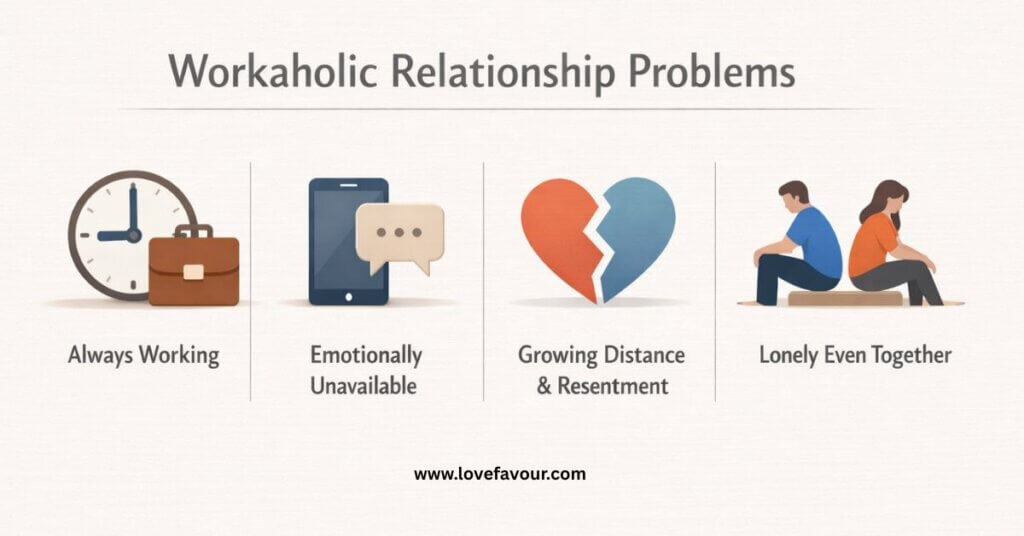
Table of Contents
What Does Being a Workaholic Really Mean in a Relationship?
Being a workaholic isn’t just about long hours. From a relationship perspective, it means work consistently comes before emotional availability, connection, and shared life.
A workaholic partner often:
- Thinks about work even when physically present
- Cancels plans due to “just one more thing.”
- Believes that providing financially equals emotional contribution
- Struggles to disconnect without guilt or anxiety
The problem isn’t ambition. The problem is when ambition replaces intimacy.
Why Workaholic Relationship Problems Are So Common
In life, work culture often rewards overworking. Hustle is praised. Burnout is normalized. Being “busy” is seen as a badge of honor. Unfortunately, relationships pay the hidden cost.
Many couples don’t realize they are dealing with workaholic relationship problems because:
- Overworking is socially encouraged
- Financial stability is prioritized over emotional presence
- Complaints are dismissed as being “needy” or “unsupportive.”
But emotional neglect doesn’t disappear just because the reason sounds responsible.
The Most Common Workaholic Relationship Problems
1. Emotional Neglect Without Intention
One of the most painful workaholic relationship problems is unintentional emotional neglect. The work-focused partner may genuinely love their spouse but has little emotional energy left at the end of the day.
The other partner feels:
- Unseen
- Unimportant
- Lonely even while in a relationship
Over time, this creates emotional insecurity and self-doubt.
2. Quality Time Gets Replaced by “Availability.”
Being physically present is not the same as being emotionally present. Many partners say, “They’re home, but they’re not really here.”
Workaholic partners often:
- Check emails during conversations
- Take calls during meals
- Mentally drift even during important moments
This makes the relationship feel like background noise instead of a priority.

3. Growing Resentment and Unspoken Anger
Resentment builds when one partner consistently feels second place. At first, it shows up as patience. Then frustration. Eventually, bitterness.
Common thoughts include:
- “I always come last.”
- “Work matters more than I do.”
- “Why am I even here?”
This resentment is one of the most destructive workaholic relationship problems because it silently erodes trust.
4. Communication Becomes Functional, Not Emotional
In workaholic relationships, conversations often revolve around logistics:
- Schedules
- Bills
- Kids
- Responsibilities
What disappears is:
- Emotional check-ins
- Vulnerability
- Playfulness
- Curiosity about each other
The relationship turns transactional rather than emotional.
Also read: How to Comfort Your Friend After a Breakup Over Text
5. One Partner Feels Like They’re Living Alone
A common experience shared in therapy sessions is feeling “single while married.”
The non-workaholic partner often carries:
- Emotional labor
- Household management
- Relationship maintenance alone
This imbalance creates exhaustion and emotional burnout.
The Psychological Impact of Workaholic Relationship Problems
From a psychological standpoint, emotional neglect triggers attachment wounds. Humans are wired for connection. When a primary partner is emotionally unavailable, the brain experiences it as rejection, even if it’s unintentional.
Over time, this can lead to:
- Anxiety
- Low self-worth
- Emotional withdrawal
- Seeking validation elsewhere
This is why workaholic relationship problems can eventually lead to emotional affairs or complete disconnection.

Why Workaholic Partners Often Don’t See the Problem
Many work-focused partners genuinely believe they are doing the right thing. In their mind:
- Working hard = loving hard
- Providing financially = fulfilling responsibility
- Sacrifice = proof of commitment
The issue is not bad intentions. It’s emotional blindness caused by chronic stress and identity tied to productivity.
Until consequences appear, many workaholics don’t realize the relationship is slowly breaking.
Signs Work Is Hurting Your Relationship
You may be dealing with workaholic relationship problems if:
- Important conversations are constantly postponed
- Date nights feel rushed or distracted
- One partner feels guilty asking for time
- Emotional needs are labeled as “drama.”
- Conflicts revolve around availability
Ignoring these signs doesn’t make them disappear.
Can Workaholic Relationship Problems Be Fixed?
Yes, but not without honest acknowledgment.
Repair requires:
- Awareness that work is affecting intimacy
- Willingness to set emotional boundaries with work
- Mutual effort, not one-sided tolerance
The goal is not to quit ambition. The goal is balance and emotional presence.
Also read: Signs He Is Hurting After the Breakup (From Real Experience)
What Actually Helps Heal Workaholic Relationship Problems
1. Redefining What “Providing” Means
Providing isn’t only financial. Emotional safety, attention, and reliability matter just as much.
Couples must redefine success as:
- Shared time
- Emotional availability
- Mutual support
2. Creating Protected Relationship Time
Work will always expand unless limited. Scheduled, protected time is essential:
- No phones
- No emails
- No work talk
This isn’t a luxury. It’s maintenance.
3. Honest Conversations Without Blame
Accusatory language creates defensiveness. Productive conversations focus on feelings, not faults.
Example:
- “I feel lonely when we don’t connect” instead of “You only care about work.”

4. Addressing the Root Cause of Overworking
Many workaholics are driven by:
- Fear of failure
- Need for validation
- Avoidance of emotional discomfort
Until this is addressed, behavior rarely changes.
When Workaholic Relationship Problems Become Deal Breakers
Sometimes, despite efforts, priorities remain unchanged. If one partner consistently refuses to make emotional space, the relationship may not be sustainable.
Love cannot survive indefinitely on leftovers.
Final Thoughts From Relationship Experience
Workaholic relationship problems don’t happen because people stop loving each other. They happen because love stops being experienced.
Relationships don’t need perfection. They need presence.
No amount of professional success replaces emotional connection at home. In the end, people don’t remember how hard you worked; they remember how you made them feel.
Frequently Asked Questions (FAQ)
1. What are workaholic relationship problems?
There are issues that arise when excessive focus on work causes emotional neglect, distance, and imbalance in a romantic relationship.
2. Can a relationship survive with a workaholic partner?
Yes, but only if both partners acknowledge the issue and actively work toward balance and emotional connection.
3. Is being ambitious bad for relationships?
No. Ambition becomes a problem only when it consistently replaces emotional availability and shared time.
4. How do I talk to my partner about working too much?
Use calm, feeling-based language and focus on how the situation affects you emotionally, not on blaming them.
5. When should I consider leaving a workaholic relationship?
If your emotional needs are repeatedly dismissed and there is no willingness to change, it may be time to reevaluate the relationship.